
Rules and ethics
UK EU packaging labelling cross-border planning guide
UK EU packaging labelling cross-border planning for UK brands: organise artwork, food-contact evidence, recycling marks and shipment documents market by market.
What to take away
- UK brands selling into the EU must meet EU packaging and labelling rules at the point of sale, as well as UK rules for the same pack at home.
- For UK EU packaging labelling cross-border planning, use one artwork grid with market-specific legal text, marks and evidence for each EU country.
- Material declarations, food contact evidence and recycling marks differ by EU market, and the differences are widest for plastic food packaging.
- Unboxing design must carry mandatory information without breaking the experience, so plan space for legal text before artwork sign-off.
- Documentation and evidence for EU-bound shipments should be assembled per SKU, per material and per destination before the print run.
- Expect longer lead times and higher unit costs for dual-specification packaging, especially where recycled content or food contact proof is required.
- Start with your highest-volume EU market, fix the pack for that market, then extend the same evidence pack to the next one.
What changed for UK brands selling into the EU after Brexit
Since the UK left the EU single market, a UK brand selling into the EU is an importer's supplier, not a domestic operator. The EU's packaging and labelling rules apply at the point the goods are placed on the EU market, which is usually when they enter the first EU country.
That is a different trigger from the UK rules you already follow at home.
The practical effect is that you now manage two rulebooks. The UK's essential requirements regime still governs packaging you place on the UK market, while EU rules govern the same product when it crosses into an EU member state. The two overlap but are not identical.
The EU-wide packaging framework includes Directive 94/62/EC on packaging and packaging waste and the newer Packaging and Packaging Waste Regulation (EU) 2025/40 (PPWR), which replaces the Directive under a phased application schedule. Check which requirements apply on the date each product is placed on the EU market; national producer-responsibility duties also need separate checks.
The UK's Packaging (Essential Requirements) Regulations 2015 set limits on volume and weight, require packaging to be recoverable, and require it to meet reuse or recovery criteria. Those duties sit with the UK producer or importer, and they still apply to UK-market sales.
Food packaging adds a second layer. If your pack touches food, the EU's plastic food contact rules apply in the EU, and the UK's own food contact regime applies at home. Food information is separate: Regulation (EU) No 1169/2011 on the provision of food information to consumers sets EU requirements for mandatory particulars, including allergens, and destination-language requirements.
The Food Standards Agency's packaging and labelling guidance sets out UK legal requirements for food businesses. Use it for UK-market checks, then assess EU food-contact and food-information requirements separately for each destination.
Cross-border unboxing is where this becomes visible to customers. A box designed for a UK launch may carry claims, marks and recycling symbols that are wrong or missing in the destination market. Fixing that after launch is far more expensive than fixing it in artwork.
Use a packaging marketing market entry checklist to map the markets you actually sell into, rather than treating the EU as one destination. The checklist approach forces you to name the member state, the product category and the packaging material before you brief a designer or printer.
Packaging and labelling differences by EU market
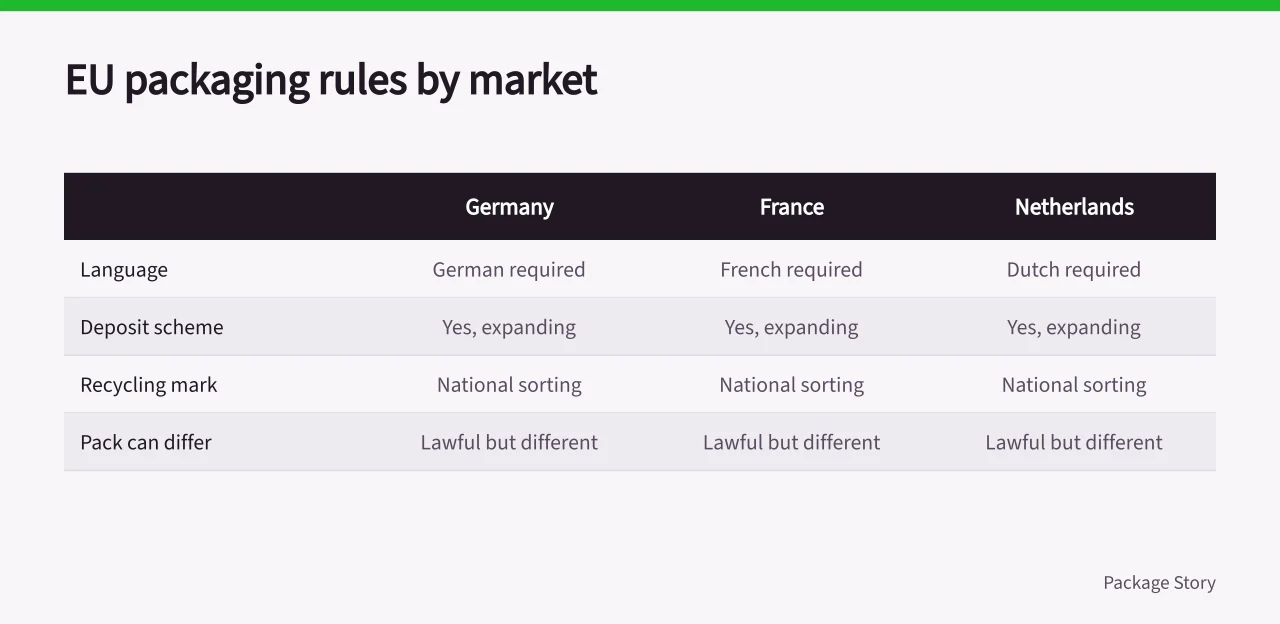
The EU has a single market, but packaging and labelling enforcement is largely national. Member states apply shared rules through their own authorities, and they add national requirements on language, deposit return schemes and recycling marks. That means your German pack, your French pack and your Dutch pack can all be lawful and still differ. The European Commission sets the shared EU framework, while national competent authorities enforce many packaging, food and product-safety requirements; confirm the competent authority for the specific obligation in each destination market.
Language is the most common tripwire. Consumer information must generally be in the language or languages of the member state where the product is sold. A UK pack in English alone is usually not enough in France, Germany, Spain, Italy or Poland, and multilingual packs add artwork complexity and press time.
Deposit return schemes are spreading across the EU. Where a country runs a deposit scheme, the pack may need a specific marking, a barcode registered with the national scheme operator, or a material-specific label. The rules differ by country and change as schemes expand.
Recycling labelling is also national in practice. Some member states expect specific sorting instructions or symbols tied to local collection systems. A generic recycling mark can be misleading if the local infrastructure does not accept that material.
Use the market table below as a planning tool, not a legal text. Confirm each line with the destination authority or your importer before you print.
Differences by EU market
| Market | Language expectation | Deposit or return scheme | Recycling or sorting mark | EPR or registration duty | Notes for UK exporters |
|---|---|---|---|---|---|
| Germany | German | Pfand deposit, run by DPG for single-use drinks; EWK single-use plastic fund registration from 2025 | Green Dot (Der Grüne Punkt) is optional and not a recycling claim; sorting instructions follow local collection | LUCID registration with ZSVR is mandatory for sales packaging | Check scheme participation and deposit barcode before print |
| France | French | Deposit return scheme for plastic bottles is being introduced; check current start date | Triman and Info-tri sorting instructions are mandatory for household packaging | ADEME registration and unique identifier are mandatory under AGEC law | French text must be present; multilingual packs are allowed |
| Netherlands | Dutch | Statiegeld deposit on plastic bottles and cans since 2021 for small bottles and 2023 for cans | Statiegeld mark on deposit packs; check the current recycling logo guidance | Afvalfonds Verpakkingen registration is mandatory | Deposit barcode must be registered with the scheme |
| Spain | Spanish | Deposit return scheme for drinks is planned under Law 7/2022; check current date | Punto Verde (Green Dot) is used under the Ecoembes scheme; confirm current mandatory status | Ecoembes registration is mandatory for household packaging | Regional languages can matter in some areas |
| Italy | Italian | No nationwide deposit return scheme for all drinks; check category rules | Environmental labelling with material codes is mandatory from 2023 | CONAI registration is mandatory | Material declarations can be detailed |
| Poland | Polish | Deposit return scheme for cans and plastic bottles starts in 2025 | National recycling mark rules apply; check current guidance | BDO registration is mandatory | Enforcement is at retail level |
For product compliance more broadly, BSI's market access guidance explains how to demonstrate that a product meets the requirements of the market you are selling into. That framing helps when a retailer asks for evidence rather than a promise.
Material declarations and food contact requirements
Material declarations are the paperwork that proves what your packaging is made of, and they are increasingly requested by EU importers and retailers. A declaration typically covers the material type, the recycled content, the presence of restricted substances, and the food contact status where relevant.
Material declaration contents
- Material type
- Recycled content
- Restricted substances present
- Food contact status
- Migration limits and test data
For plastic packaging that touches food, the EU's Commission Regulation (EU) No 10/2011 sets the rules for plastic materials and articles intended to come into contact with food. It covers authorised substances, migration limits and the documentation needed to show compliance.
That regulation matters for UK exporters because the pack is assessed in the EU, not in the UK. If your pouch, tray, film or bottle is plastic and touches food, you need evidence that the material and any additives meet the EU rules for the intended use, including time and temperature.
Declarations of Compliance are the usual vehicle. They are issued by the material or converter stage and passed along the supply chain. If your supplier cannot provide one for the EU, your importer carries the risk, and many will refuse the shipment.
Non-plastic food contact materials, such as paper, board and coatings, are covered by national rules and general safety requirements rather than the plastics regulation. Paper and board food packaging often needs a declaration covering fibre source, coatings and any barrier layer.
Keep declarations per SKU and per material. A single declaration for a product family is rarely enough when the film, the tray and the label come from different suppliers. BSI's standards catalogue is where you find the specifications that underpin these tests and declarations, so you can brief suppliers in their language.
Recycling marks and how they differ from UK on-pack labels
UK on-pack recycling labels are familiar and relatively stable, but they are not the same as EU recycling marks. The UK label tells consumers what to do with the pack at home. EU marks often do the same job but with different symbols, different sorting logic and different legal footing.
UK vs EU recycling marks
UK on-pack label
- Purpose
- Consumer disposal
- Green Dot
- Not used
- Material codes
- Familiar
- Enforcement
- ASA and CMA
EU recycling marks
- Purpose
- Sorting and recovery
- Green Dot
- Scheme payment, not recyclability
- Material codes
- May mislead locally
- Enforcement
- National authorities
The Green Dot is the classic example. It indicates that a producer has paid into a packaging recovery scheme, not that the pack is recyclable. Using it as a recycling claim is a common mistake, and in some markets it is required while in others it is optional or absent.
Material identification codes are another difference. The Mobius loop with a resin code identifies the material, but local collection systems may not accept it. A pack can carry a technically correct code and still mislead a consumer about local recycling.
Under UK rules, green claims are policed by the Advertising Standards Authority and the Competition and Markets Authority. The CMA's green claims guidance expects claims to be truthful, clear and substantiated, and that discipline is a useful test for EU packs too. Poorly evidenced recycling claims attract attention in both markets.
Use this checklist before signing off EU artwork:
- Confirm the recycling mark expected in each destination market.
- Check whether the mark is mandatory, voluntary or absent in that country.
- Verify that the material is actually collected locally before claiming recyclability.
- Separate scheme marks such as the Green Dot from recycling claims.
- Check that sorting instructions are in the correct language.
- Keep evidence for every environmental claim on the pack.
- Review claims against UK rules as well, so one pack does not breach either market.
For a deeper look at how printed claims must be proven rather than asserted, see packaging marketing rules and ethics. It sets out the standard your EU claims will also be judged against by UK regulators.
Cross-border unboxing design for UK and EU rules
Unboxing design is where compliance meets the customer. The pack has to carry mandatory information, and it also has to feel considered when it is opened. Those two goals compete for the same surface area.
Designing for two rulebooks
- List mandatory elements per market
- Put legal text on outer pack
- Keep inner layer for storytelling
- Use a shared grid across markets
- Plan language variants early
- Test unboxing with legal layer
Start with the legal layer. List the mandatory elements for each destination market: product name, quantity, ingredients or materials, allergens and importer details. Add country of origin where required, plus any deposit or scheme marks, recycling marks and sorting instructions.
Then design the experience around the space that is left. Put mandatory text on the outer pack where it can be read without opening, and keep the inner unboxing layer for brand storytelling and the product itself. That separation lets you change legal text without redesigning the inner experience.
Use a consistent grid across markets. If the German pack needs more text than the Dutch pack, a shared grid keeps the layout recognisable while allowing the text block to grow. This reduces artwork errors and speeds up localisation.
Plan for language variants early. Multilingual packs can work well for small markets, but they increase the risk of a translation error in a mandatory statement. Keep mandatory statements short, and have them checked by a native speaker in each market.
Test the unboxing sequence with the legal layer in place. A pack that looks clean in a design file can feel cluttered when the mandatory text is added. Physical prototypes, printed on the final substrate, are the only reliable test.
If you are reviewing your UK obligations alongside EU ones, our guide to packaging marketing UK regulations explains what to check before you print. It is a useful companion when one artwork has to serve both markets.
Documentation and evidence for EU-bound shipments
Documentation is what turns a compliant pack into a shipment that clears the border and satisfies the importer. Build the evidence pack before the print run, not after.
EU shipment evidence pack
- Specification sheet per component
- Declarations of Compliance
- Recycled content evidence
- Recycling mark artwork per market
- Signed-off language versions
- Importer and responsible person details
- Change log
A practical evidence pack for each SKU includes:
Documentation and evidence
- A specification sheet listing every packaging component, its material and its weight.
- Declarations of Compliance for food contact materials, including migration test data where relevant.
- Recycled content evidence where the pack claims recycled material.
- Recycling mark and sorting instruction artwork for each destination market.
- Language versions of all mandatory text, signed off by a native speaker.
- Importer and responsible person details for each market.
- A change log so you can show what changed and when.
Consumer product safety duties are separate from packaging rules. The General Product Safety Regulation (EU) 2023/988 (GPSR) requires an EU-established responsible economic operator for products covered by it and includes product identification, traceability, safety and contact-information duties. Work out which operator has that role for each route to market; it is not automatically the EU entity that first places the goods on the market, and selling direct does not by itself mean that you must appoint an authorised representative in every member state.
EPR registration is separate. Most member states require the producer, importer or distributor to register with a national scheme and pay fees based on material and weight. Germany uses LUCID, the packaging register operated by Zentrale Stelle Verpackungsregister (ZSVR); France uses ADEME, the Netherlands uses Afvalfonds Verpakkingen, Spain uses Ecoembes, Italy uses CONAI and Poland uses BDO.
Before launch, confirm the current registration threshold, fee band and registration route with the named national scheme; these vary by market and packaging.
Keep the pack versioned. When a supplier changes a film or a coating, the declaration may need updating, and the artwork may need a new recycling mark. Version control prevents an old declaration being used for a new material.
Retailers and importers increasingly ask for this evidence as part of onboarding. Having it ready shortens the listing process and reduces the chance of a delisting when a rule changes.
For a worked example, take a UK snack brand shipping a plastic film pack into Germany and France. The film needs an EU Declaration of Compliance covering the plastic regulation. Germany needs German mandatory text and a scheme-compliant barcode if the pack falls within the deposit scheme.
France needs French text and the national sorting mark. The same film specification serves both markets, but the artwork and the evidence pack differ.
Cost and lead time implications for packaging runs
Dual-specification packaging costs more than a single UK run, and the increase is not evenly spread. Artwork, plate changes, material certification and shorter runs drive most of it.
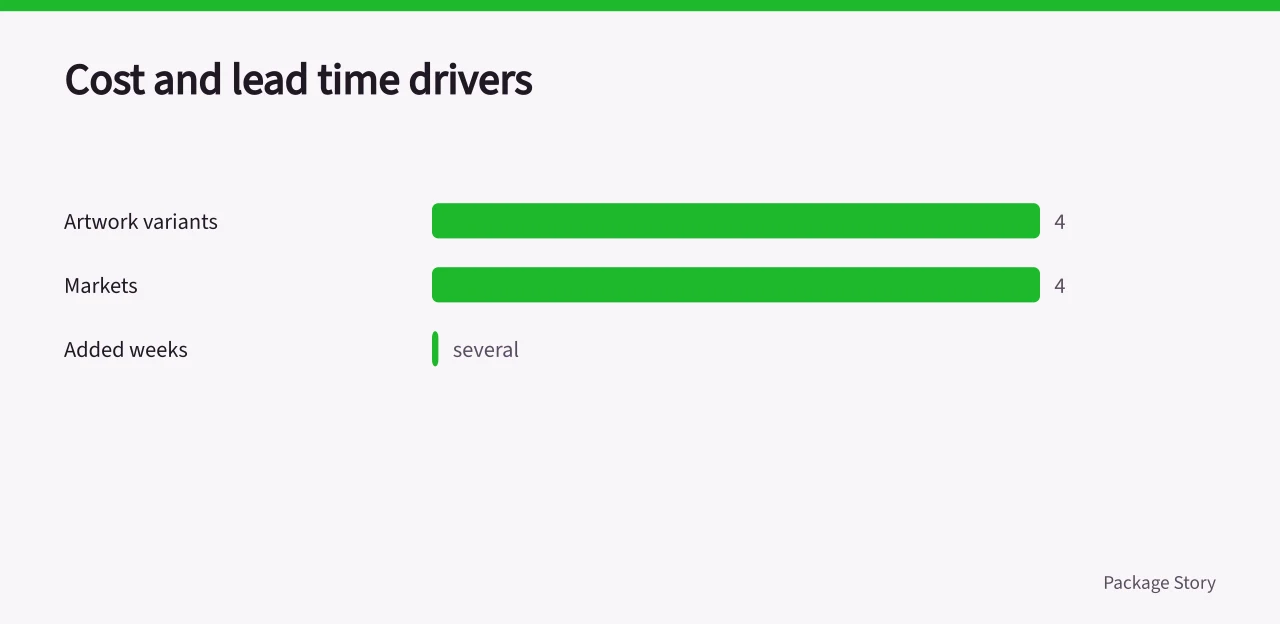
Artwork and pre-press are usually the first cost to rise. Each language version and each market-specific mark needs its own version, and each version needs proofing. A pack sold in four EU markets can mean four artwork variants before you print anything.
As a typical range, each artwork variant can add a few hundred pounds in design and proofing time. Plate changes for a new version can add several hundred pounds per colour, and a full set of plates for one market can run into low thousands. These figures depend on your printer, substrate and number of colours.
Print economics work against small variants. Longer runs lower the unit cost, but market-specific packs split the volume. If Germany needs one version and France another, neither reaches the most efficient run length, so unit costs rise.
Material certification adds a fixed cost per material, not per unit. Declarations of Compliance, migration testing and recycled content certification are one-off or periodic costs, but they must be budgeted before the first EU shipment.
Certification and testing can add low hundreds to low thousands of pounds per material, depending on the test package.
Lead times stretch for three reasons. First, artwork rounds multiply with languages and marks. Second, certification and testing take time, especially for food contact materials. Third, some markets require registration or scheme onboarding before packs can be sold.
As a planning range, allow one to two weeks per additional artwork variant, and two to four weeks for food contact certification or migration testing. Scheme registration can add another two to six weeks in markets such as Germany, France or Poland.
A realistic planning assumption is to add several weeks to your first EU pack and to treat the first run as a learning run. Once the evidence pack and the artwork grid exist, later markets are faster and cheaper because you are reusing structure rather than starting again.
Where you can, standardise materials across markets. A single film or board specification that meets the strictest of your destination markets reduces the number of declarations and simplifies artwork. Standardisation is the main lever UK exporters have over cross-border packaging cost.