

Costs and pricing
Before you set a packaging marketing budget, read this cost guide
A practical guide to packaging marketing costs and pricing in England, covering print, tooling, fulfilment, Plastic Packaging Tax and how to score a supplier quote.
What to take away
- Most teams build a packaging marketing budget from the unit price on a printer's quote and stop there. The costs that break the budget sit either side of that figure.
- Structural tooling, artwork, freight, storage and waste disposal usually add a meaningful margin on top of print. The Plastic Packaging Tax adds a flat charge per tonne of plastic with less than 30% recycled content.
- A budget is easier to defend when it is split into four lines: design and artwork, print and materials, fulfilment and unboxing extras, and media or content, then measured against a defined return.
- Quotes are only comparable once you have standardised the specification, the quantity band and the incoterm, because each changes the headline price.
- Score every supplier against the same rubric before you negotiate, not after.
Why unit price misleads
The first mistake is treating packaging as a print purchase. It is a production project with a design phase, a tooling phase and a logistics phase, and each has its own cost behaviour.
Quote variables that move unit price
Fixed spec
- Size
- Quoted size
- Board
- Quoted board
- Finish
- Quoted finish
- Quantity band
- Quoted band
Changed spec
- Size
- New size
- Board
- New board
- Finish
- New finish
- Quantity band
- New band
A printer quotes per thousand units at a fixed size, board and finish. Change any of those and the price moves. Change the quantity band and the price per unit moves again, because setup costs are spread across the run. That is why two quotes for the same box can differ by more than the print itself.
Quotes differ mainly on material, print method, run length and artwork revisions. Agency day rate matters less than those four.
Before you approve a budget, compare total cost per shipped order at three volumes, not cost per unit from one quote.
Marketing teams also forget that packaging is bought in cycles. A run that lasts nine months ties up cash and warehouse space. A run that lasts three months costs more per unit but frees working capital. Neither is wrong, but the choice belongs in the budget, not in a later conversation with finance.
If you want to see how suppliers structure this commercially, our breakdown of packaging marketing pricing models in England explains the difference between per-unit, retainer and hybrid arrangements.
Cost lines to budget
Four groups cover the spend and each behaves differently as volume moves.
| Group | What it covers | Illustrative range (ex VAT) | Volume behaviour |
|---|---|---|---|
| Design and artwork | Dielines, mockups, print-ready files | £450 to £6,000 per project | Mostly fixed |
| Print and materials | Substrate, print, finishing, tooling | £0.40 to £1.80 per unit | Steps down with run length |
| Fulfilment and unboxing extras | Inserts, tape, void fill, packing labour | £0.20 to £0.60 per order | Scales with orders |
| Media and content | Filming, ads, creator fees | £300 to £3,000 per month | Scales with ambition |
Figures are illustrative and exclude VAT.
Design and artwork
Expect to pay for structural design, dielines, mockups and print-ready artwork. A simple carton is a few days of studio time. A rigid box with inserts, foiling and a custom tray is a project.
Cost lines to budget
- Design and artwork
- Tooling and setup
- Production
- Freight, storage and waste
Budget for at least one physical prototype round. Digital proofs catch colour, but they do not catch how a lid feels or whether an insert holds a bottle upright in transit.
Tooling and setup
Die-cut tools, print plates, foil blocks and embossing dies are one-off costs. They are usually charged separately and occasionally amortised into the unit price. Ask which, because it changes your break-even quantity.
Tooling is also asset-like. If you change supplier, you may need to pay for it again, or negotiate to move the existing tool.
Production
This is the line everyone budgets for. It includes substrate, print, finishing, assembly and packing. Substrate is the most volatile element, so treat any quote held for more than a month as indicative.
The Office for National Statistics publishes producer price indices that track input costs across manufacturing, which is a more defensible reference point than a supplier's anecdote about paper prices. The ONS inflation and price indices are worth checking before you accept a price increase.
Freight, storage and waste
Pallets, shrink wrap, inbound freight, duty where relevant, and warehouse space all sit here. So does waste: damaged stock, obsolete packaging after a design change, and the cost of disposing of what you cannot use.
For example, a brand holding 20,000 obsolete mailer boxes at a unit cost of £0.40 is writing off £8,000 of stock, plus disposal. That is an illustrative figure, but the pattern is common.
Compliance and tax
The Plastic Packaging Tax applies to plastic packaging manufactured in or imported into the UK that contains less than 30% recycled plastic. The Finance Act 2021 introduced it, and the rate is set per tonne, so the exposure scales with weight rather than unit count.
The rate is £228.82 per tonne from 1 April 2026 (it was £223.69 from 1 April 2025), above a 10 tonne a year threshold.
Compliance also covers labelling, recyclability claims and food-contact rules where relevant. Claims on pack are advertising claims, and the Advertising Standards Authority publishes rulings on packaging and advertising claims that are useful due diligence before you print a sustainability statement.
Media and content
Media and content covers filming, ads and creator fees. The budget depends on how much you commission and how often you refresh it.
Illustrative budget example
Below is a worked example for a fictional skincare brand ordering 25,000 printed mailer boxes with a custom insert. Every figure is illustrative and labelled as such. It is not a market rate.
Illustrative budget: 25,000 mailer boxes
- £28,200Total illustrative cost
- £1.13Illustrative cost per unit
- £13,000Print and finishing line
- £1,300Contingency at 10%
| Line | Basis | Illustrative cost |
|---|---|---|
| Structural design and artwork | Fixed project fee | £3,500 |
| Prototypes | Two rounds | £900 |
| Die-cut tool | One-off | £1,200 |
| Print and finishing | 25,000 units at £0.52 | £13,000 |
| Custom insert | 25,000 units at £0.18 | £4,500 |
| Inbound freight | Four pallets | £1,400 |
| Storage | Six months | £1,800 |
| Plastic Packaging Tax | Estimated exposure | £600 |
| Contingency | 10% of production | £1,300 |
| Total | £28,200 |
Per unit, that is roughly £1.13. The print line is less than half the total. That gap is the reason a unit-price conversation with a printer rarely settles a budget.
Where budgets leak
The costs that surprise teams are rarely the ones on the quote. They are the ones nobody owned.
Most of these costs trace back to material, print method, run length and artwork revisions, not the agency day rate.
Where budgets leak
- Artwork revisions
- Quantity changes
- Supplier switches
Artwork revisions are the most common. Every additional round of amends adds studio time, and late amends can push a print slot back, which can trigger expedited freight.
Quantity changes are the second. Order too few and you pay a premium for a short run. Order too many and you pay for storage and eventually disposal.
Supplier switches are the third. Moving a job mid-cycle means new plates, new proofs and a new setup, even if the specification is identical.
We cover these in more detail in our guide to packaging marketing hidden costs in England, which lists the line items that most often appear after sign-off.
Forecasting demand
Budget accuracy depends on volume accuracy. If your forecast is wrong by 20%, your unit cost is wrong by more than 20%, because setup costs are fixed.
Forecasting demand for budget accuracy
- Use sell-through data from comparable period
- Adjust for promotions and seasonality
- Forecast in shorter cycles without history
- Agree reorder trigger with supplier
Use sell-through data from the previous comparable period, then adjust for planned promotions and seasonality. Where you have no history, forecast in shorter cycles and accept a higher unit cost in exchange for flexibility.
BSI publishes material on predictive analytics for demand forecasting that is relevant if you are building a more formal model rather than extrapolating from a spreadsheet.
One practical rule: agree a reorder trigger with your supplier in advance. A stated lead time and a stated minimum order quantity let you plan the second run before the first one runs out.
Setting the return side
A packaging budget is only half a business case. The other half is what the packaging is supposed to do.
If the objective is a better unboxing experience, the measure might be repeat purchase rate or social sharing. If the objective is reduced damage, the measure is returns and replacement cost. If the objective is shelf presence in retail, the measure is rate of sale.
Pick one primary measure before you brief a designer. Packaging that tries to do everything usually costs more and proves nothing.
Our framework for packaging marketing return on investment sets out how to attribute a revenue or retention effect to a packaging change without overclaiming.
Customer engagement research is also useful here. The Data & Marketing Association publishes research on customer engagement and marketing performance that can help you choose a measure your finance team will accept.
Supplier quote scoring rubric
Use the same rubric for every quote. Score each criterion from 1 to 5, then weight it. The weights below are a starting point, not a rule.
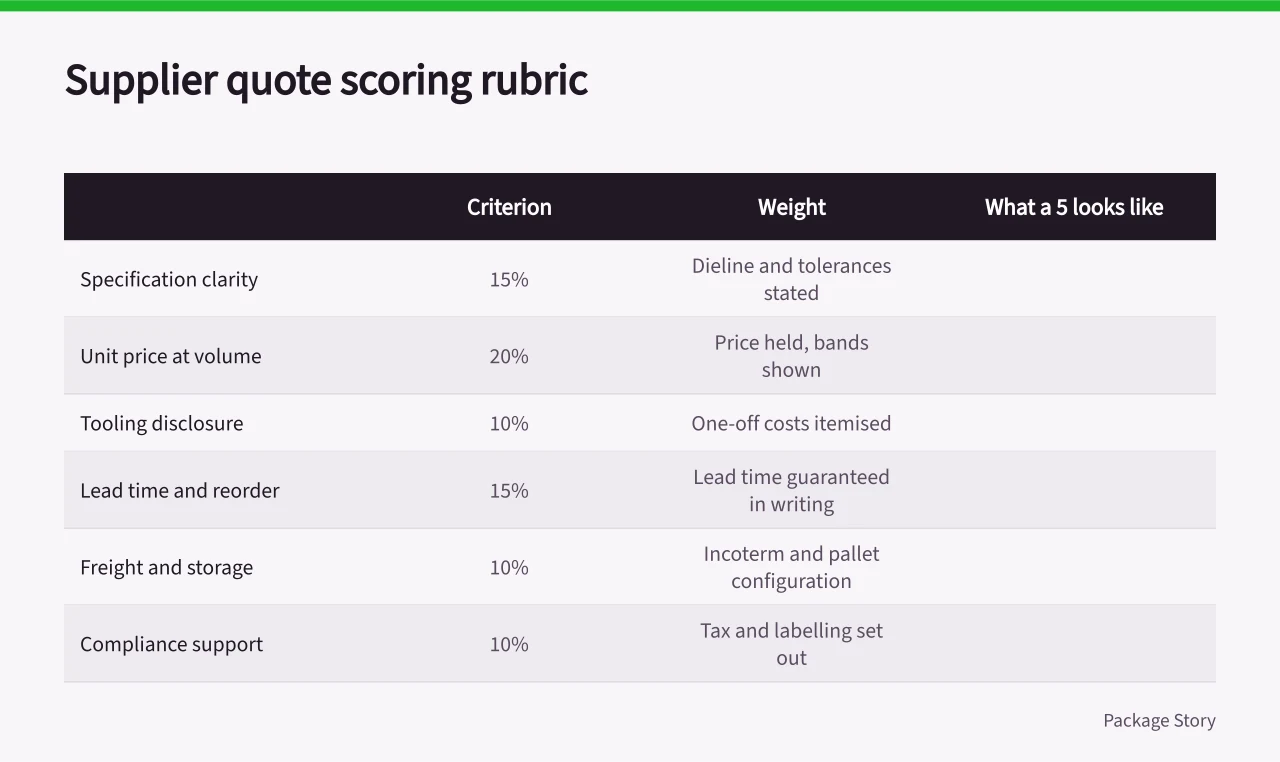
| Criterion | Weight | What a 5 looks like |
|---|---|---|
| Specification clarity | 15% | Dieline, substrate, finish and tolerances all stated |
| Unit price at your volume | 20% | Price held for a defined period, quantity bands shown |
| Tooling and setup disclosure | 10% | One-off costs itemised, ownership stated |
| Lead time and reorder terms | 15% | Lead time guaranteed, MOQ and reorder lead time in writing |
| Freight and storage terms | 10% | Incoterm stated, pallet configuration given |
| Compliance support | 10% | Tax and labelling responsibility set out clearly |
| Sustainability evidence | 10% | Recycled content evidenced, claims substantiated |
| Sample and proof process | 10% | Number of proof rounds and costs defined |
Score each supplier, multiply by the weight and total. A supplier that wins on unit price often loses on lead time and compliance support, and that trade-off should be visible before you sign.
Timing the spend
Packaging is a lead-time purchase, so the budget year and the production year rarely align. A job briefed in November may not ship until February.
Place the commitment in the period when you pay for it, not the period when you brief it. Otherwise your monthly variance looks alarming for reasons that are purely timing.
If you are planning beyond the current year, our outlook piece on packaging marketing trends and outlook for England in 2027 covers the direction of material costs, recycled content requirements and buyer expectations.
Building the budget document
Keep it to one page per packaging project. Finance teams approve documents they can read.
Include the specification, the quantity, the four cost lines, the tax position, the lead time and the primary measure. Add the contingency and say what would trigger it.
Then add a single line for the cost per unit at the volume you actually expect, and a second line at the volume you would order if sales were 20% below plan. That second line is the one that protects you.
Costs, pricing and commercial assumptions belong in one place. Review the document when the specification changes, not only when the invoice arrives.
Common questions
What does packaging marketing cost in England?
There is no single rate. Cost depends on substrate, print method, quantity, finishing and tooling. For a mid-volume printed carton, print and finishing often sit between half and two thirds of total project cost, with tooling, freight, storage and tax making up the rest. Treat any figure you are given without a specification as indicative only.
Does the Plastic Packaging Tax apply to my packaging?
It applies to plastic packaging manufactured in or imported into the UK with less than 30% recycled plastic content, and the rate is charged per tonne. The Finance Act 2021 introduced the tax. Check whether your components are in scope, and ask your supplier for recycled content evidence in writing.
How many quotes should I get?
Three is usually enough to test the market, provided all three are built on the same specification and quantity band. More quotes add work without adding much information. Score them with a rubric so the comparison is about terms, not just price.
Should I order a longer run to reduce unit cost?
Sometimes. A longer run lowers the unit price but raises storage, obsolescence and cash exposure. Compare the saving per unit against the cost of holding the stock and the risk of a design change making it unusable.
Can I claim a packaging is recyclable on the pack?
Only if you can substantiate it. Packaging claims are advertising claims, and the ASA publishes rulings on claims it has considered. Keep the evidence for any environmental statement on file before the pack goes to print.
Do unboxing extras pay for themselves?
Only if you can measure the return. Inserts, tissue, tape and void fill add cost per order. Test one extra against a control, then keep it only if the lift covers its cost.
Should I price per unit or per order?
Price per shipped order when you build a budget, because it includes fulfilment and extras that a unit price leaves out. Use per unit only to compare quotes at one specification and volume. Show both when finance asks for a unit figure.
In this guide
- Packaging marketing pricing models compared for England buyersHow retainer, project, per-unit and performance packaging marketing pricing models compare on cost, risk, cash flow and measurement for England buyers.
- When to build a packaging marketing budget template for EnglandWhen a packaging marketing budget template is worth building in England, with a before and after table, cost lines in pounds and the rules that shape spend.
- How to measure packaging marketing return on investment for parcelsWork out packaging marketing return on investment as incremental gross profit per parcel: price every extra, run a control test and set your pass mark first.
- Planning packaging budgets beyond the print quoteA qualitative guide to packaging costs beyond the print quote, covering artwork, compliance, supplier resilience, demand and unboxing choices.